

Just over two weeks after Harghita County earned a place in the Green Destinations TOP100 Stories selection, announced in Kranj on October 28, the Romanian region has received another major international recognition. Its project, built around Szekler gastronomy, local products and living traditions, has been selected among the six finalists in the Culture & Heritage category.
The category finalists were announced on November 12 at the Green Destinations gala held during ITB Americas. The event was opened by Liz Blanca Chirinos Cuadros, Peru’s Deputy Minister of Tourism, followed by Noah Pircher, Programme Director of Green Destinations, and Emma Magistri, Project Coordinator of the TOP100 Good Practice Competition, who presented the six leading destinations in each category.
Reaching the finals is a significant international achievement for Romania and Harghita County, which now competes alongside two destinations from Japan, two from Slovenia and one from Montenegro for a place on the podium. The competing destinations have spent years developing sustainable tourism initiatives and protecting their cultural heritage. Among the finalists are destinations holding international sustainability certifications, communities preserving nationally protected cultural traditions, and a heritage conservation initiative recognised with a Europa Nostra Award.
From the TOP100 Selection to the Podium in Berlin
The Green Destinations TOP100 Stories programme recognises sustainable tourism practices that have already been implemented and demonstrated measurable results. The selection process consists of three stages. First, outstanding projects are included in the annual TOP100 Stories selection. From these, six finalists are chosen in each category. The three podium positions will then be announced at ITB Berlin in 2027. Harghita County has therefore already secured a place among the six category finalists, while the final rankings have yet to be determined.
Six Projects Dedicated to Preserving Living Heritage
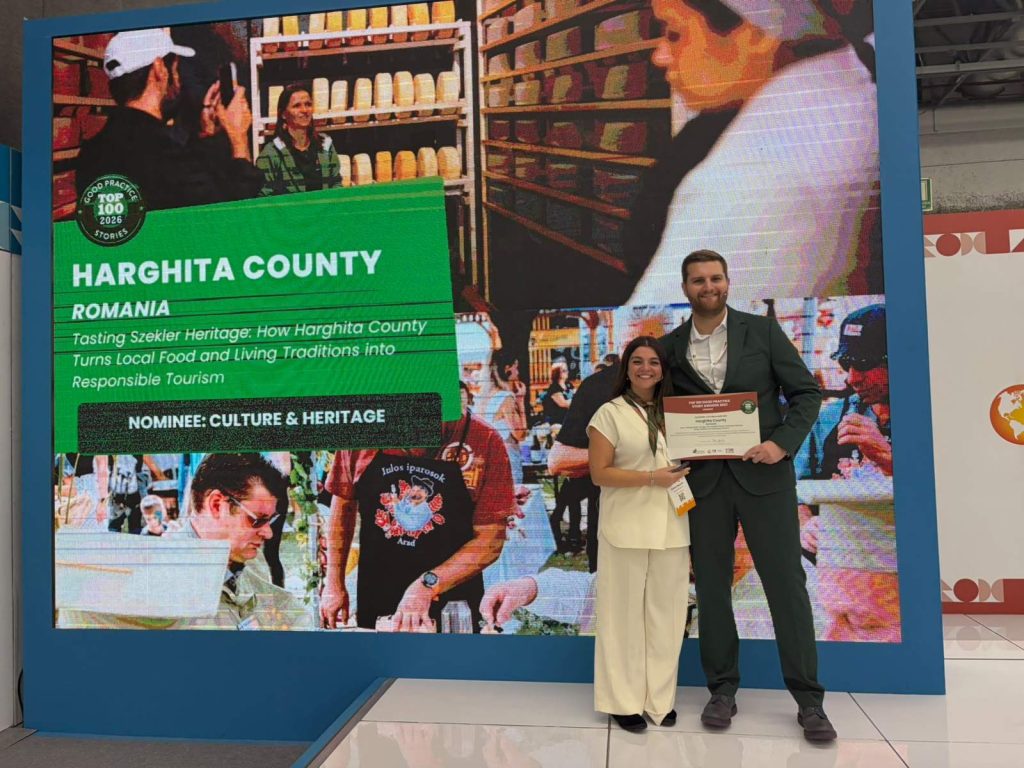
Harghita County, Romania – Traditions Can Only Survive if Their Keepers Have a Future
The true value of a locally produced cheese, a family recipe passed down through generations or a traditional costume lies with the people who have preserved these traditions over time. Harghita County’s project explores how tourism can provide livelihoods and recognition for these communities while ensuring that their heritage retains its authenticity, rather than becoming an anonymous commodity or a performance staged for visitors.
Harghita County Council and the Harghita Community Development Association (Visit Harghita) have developed a network connecting local producers, tourism businesses and hospitality providers, from protecting the origins of regional products to bringing them directly to visitors’ tables.
Established in 2009, the Szekler Product trademark represented nearly 200 producers and approximately 1,500 products by 2024. The Szekler Product 2.0 initiative uses QR codes to introduce customers to the people and stories behind the products, while the Open Farm programme allows visitors to discover where their food comes from by visiting working farms.
The Myrmidone (Orange Butterfly) restaurant certification applies the same principles to the hospitality sector. Its requirements include sourcing ingredients from within a 100-kilometre radius, working with local producers, serving regional dishes and reducing food waste. Compliance is verified through on-site inspections. A survey involving 62 tourism service providers, conducted in support of the application, found that three-quarters of respondents prioritised local products.
Another important aspect of the initiative is the communities’ right to decide which traditions they wish to share with visitors and which should remain part of their own cultural and spiritual lives. The Day of a Thousand Szekler Girls and the pilgrimage to Șumuleu Ciuc (Csíksomlyó) are primarily occasions of community identity and religious faith. Traditional costumes and dancing remain genuine expressions of living culture rather than performances arranged for tourists.
The Harghita County approach seeks to ensure that tourism supports the continuation of local traditions while leaving decisions about their presentation in the hands of the communities themselves. This philosophy also forms an important part of the county’s preparations for 2027, when Harghita will hold the title of European Region of Gastronomy.
Competition is strong, however, as the other five finalists have also achieved remarkable results in safeguarding their cultural heritage through sustainable tourism.
Jeruzalem Slovenia, Slovenia – A Castle Transformed into a Gateway to Regional Culture. Ormož Castle, previously accessible to visitors only on a limited basis, has been transformed into a cultural centre open throughout the year. The reopening of its tower was accompanied by a historical film produced with local participants, a community project collecting personal memories and the training of 27 castle guides. The castle now serves as a starting point for discovering nearby wineries, farms and cultural attractions. Following an annual visitor count of around 1,300, the site welcomed more than 5,000 people in just five months. It has held the Slovenia Green Attraction recognition for four years.
Ena, Japan – A Living Town Rather Than an Open-Air Museum. In Iwamura, a community facing population decline and ageing, the first priority was to strengthen residents’ connection with their heritage. Local history education in schools and community efforts to maintain historic streets and rice terraces laid the foundations for new tourism experiences. These were followed by craft workshops, culinary activities and lantern walks offering opportunities to meet local residents. Seventeen new businesses opened over nine years. The Iwamura Plan, recognised with a ministerial award in 2019, demonstrates how residents’ pride in their heritage can generate lasting tourism value.
Kotor, Montenegro – Preserving Lace Means Passing on the Skills to Make It. Despite its protected cultural status, the 600-year-old tradition of Dobrota needle lace was at risk of disappearing. By 2021, only one recognised master remained capable of passing on the craft. A museum-led initiative introduced six-month training courses, carefully preserving the original techniques while developing a new community of lace makers. Around 60 participants have completed the courses, and three are already teaching others. Demonstrations now offer visitors an opportunity to engage more deeply with local culture beyond conventional sightseeing. The Pacijenca programme received a Europa Nostra Award in 2026.
Radlje ob Dravi, Slovenia – A Castle and a Forest Sharing the Same Story. This Slovenia Green Destination Gold-certified municipality has brought Franjo Pahernik’s century-old legacy of nature-friendly forestry to a wider audience. An interactive exhibition and virtual forest experience in a renovated castle introduce visitors to his approach, complemented by guided visits to the surrounding forests. Visitors can discover firsthand how responsible forestry practices shape the landscape. Digital technology also makes this heritage accessible to people unable to reach the more remote forest areas.
Toge, Japan – Turning Visitors into Guardians of Cultural Heritage. In the sacred Dewa Sanzan mountains, deteriorating cedar trees and the declining number of pilgrim lodgings prompted residents, accommodation providers and religious communities, which had previously operated largely independently, to work together. Their cooperation over several years resulted in a local currency, a shared management structure and a visitor contribution scheme. In just two months, more than 22,000 visitors contributed over 15 million Japanese yen towards protecting the cedar trees. The heritage, recognised under the Japan Heritage programme since 2016, now benefits from a dedicated community-based funding mechanism.
The Green Destinations TOP100 Stories programme celebrates sustainable tourism initiatives that have already produced tangible results. The process begins with the annual TOP100 selection, from which six finalists are chosen in each category. The three winning projects and their final rankings will be revealed at ITB Berlin in 2027. Harghita County has successfully completed the second stage and is now among the six finalists in its category.
A Major Achievement for Romania and Harghita County
The significance of reaching the category finals becomes even clearer when considering the achievements of the competing destinations. Harghita County is competing against destinations with years of experience in sustainability and heritage conservation, supported by professional certifications and prestigious international awards. Among them is a county-wide initiative rooted in Szekler traditions, bringing together the protection of local product origins, the development of regional gastronomy and respect for community celebrations and cultural practices.
The recognition is also important for Romania, demonstrating how the living cultural heritage and traditional knowledge of its rural regions can contribute to internationally recognised approaches to sustainable tourism development. For Harghita County, the result confirms the value of supporting local producers, preserving cultural traditions and developing tourism experiences that strengthen the region’s international visibility.
The application was prepared by Innotime Hungary Ltd. on behalf of the Harghita Community Development Association (Visit Harghita). The next stage of the competition will take place in Berlin, but securing a place among the six best projects in the Culture & Heritage category already represents a major international professional recognition for Harghita County.


